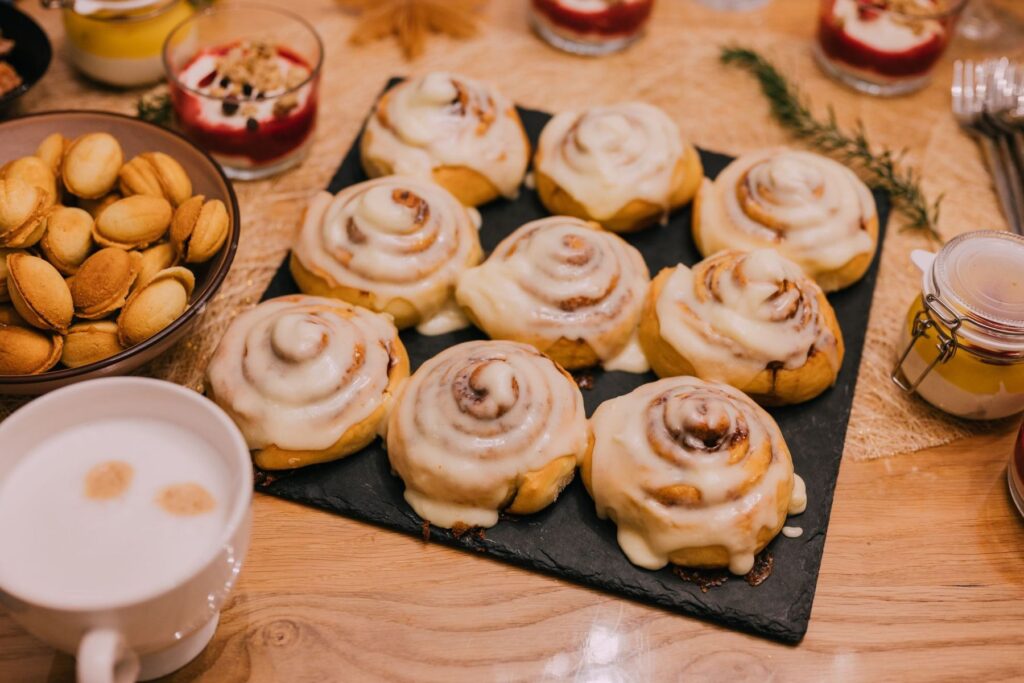
Most of a good Christmas brunch can be made the day before. Bread soaked in custard, cinnamon rolls and baked oatmeal all hold well overnight in the fridge, and the strata and French toast bakes taste better for it, so the morning job shrinks to switching on the oven and pouring coffee.
The catch is the oven. Several dishes that each want it for close to an hour will not all fit at once, and a glass baking dish carried from a cold fridge into a hot oven can crack. Egg dishes on a buffet also come with a firm time limit once they leave the oven.
Every baked dish below shares one oven temperature, so two pans can go in together. Everything here is vegetarian, and the drinks are sorted the day before too.
1. Spinach and cheese strata
A strata is a savory bread pudding: cubes of bread layered with cheese and vegetables, drowned in eggs and milk, then left to soak. The soak is the point. Deb Perelman, the cook behind the blog Smitten Kitchen, explains, in a reply to a reader under her spinach and cheese strata, that the long rest gives the bread time to absorb the custard, while a strata baked straight away eats more like toast. Her version chills for at least 8 hours and up to a day, then bakes at 350°F for 45 to 55 minutes and rests for 5.
Use dry bread so it soaks without going to mush. America’s Test Kitchen dries its bread slices in a 225°F oven for about 40 minutes, then weighs the assembled dish down overnight with about 2 pounds, such as a couple of boxes of sugar, so every piece stays under the custard. Cook any vegetables first and squeeze greens dry, or their water ends up in the eggs. Sautéed mushrooms and caramelized onions add savory depth.
2. Overnight French toast bake
This is French toast without standing at the stove flipping slices. For NPR’s Kitchen Window column, recipe writer T. Susan Chang laid 8 thick slices of challah or brioche in a 9×13 glass dish, poured over 6 eggs and 2 cups of milk, soaked them for 15 minutes, flipped them and refrigerated the dish overnight. It bakes at 350°F for 40 to 45 minutes under a hazelnut crumb topping that is also made the night before, and serves four.
It is also one of the oldest ways to use up bread. A sweet soaked-bread dish turns up in a Roman cookbook credited to Apicius, and the French name, pain perdu, means “lost bread,” probably because it rescued loaves going stale, Smithsonian Magazine reports.
3. Apple and cherry stuffed French toast strata
For a fruit-filled version, the What’s 4 Dinner newsletter from Elizabeth Karmel, who has designed kitchen tools for more than 15 years, sautés the apples and dried cherries a couple of days ahead. The bread cubes sit out uncovered for a couple of hours to firm up, then the dish is assembled and chilled overnight. It bakes at 350°F for 60 to 70 minutes, with a first check at 35 to 40 minutes, and rests for 10 before slicing. The newsletter’s point is that once it is in the oven, juice and coffee are the only jobs left.
4. Overnight cinnamon rolls
Yeast dough slows right down in the fridge, which is why cinnamon rolls work as a night-before job. In King Arthur Baking’s guide to overnight breakfast baking, baker and writer PJ Hamel shapes the rolls, lets them rise about three-quarters of the way, then refrigerates them overnight. She suggests stopping at half a rise for a lean dough (less than a tablespoon of butter per cup of flour) or a glass or ceramic pan. In the morning the rolls sit covered on the counter while the oven heats. King Arthur’s Now or Later Cinnamon Buns bake at 350°F, and buns straight from the fridge need about 5 minutes more than the usual 20 to 23.
There is a second route. Cook and writer Alison Roman’s cinnamon roll recipe, which comes with a video, chills the mixed dough for 12 to 24 hours before it is rolled out, which slows the rise and firms the butter so the dough is easier to roll.
5. Baked oatmeal
Baked oatmeal is the one bake here without bread, and it is the easiest. The Mayo Clinic’s baked oatmeal mixes 3 cups of rolled oats with skim milk, applesauce, egg whites and 2 teaspoons of baking powder the night before. In the morning it bakes at 350°F for 30 minutes in a 9×13 pan and serves eight. Top it with fruit and a spoonful of yogurt at the table.
6. Overnight oats in jars
Overnight oats need no oven at all, which helps when the oven is full. King Arthur Baking’s simple overnight oats use equal parts rolled oats and milk by volume, chill for at least 4 hours and keep for up to 3 days. Make them in small jars and they double as a grab-and-go option for anyone who wakes early or sleeps late. Set out maple syrup, nuts and berries so guests can finish their own.
7. A fruit salad that doesn’t brown
Fruit is the one thing to leave partly for the morning. Apples, pears, bananas and peaches turn brown once cut, because enzymes in the cut flesh react with air, writes Alice Henneman, a registered dietitian with University of Nebraska-Lincoln Extension. She recommends coating them in lemon, orange or pineapple juice, or a mix of 2 tablespoons of honey to 1 cup of water. Prep the rest of the bowl the night before, cut the browning fruit last, and keep the bowl covered and cold until it goes out.
8. Cold brew concentrate
Coffee for a crowd is easiest made a day ahead as a concentrate. Toddy’s brewing instructions call for 12 ounces of coarsely ground coffee to 7 cups of water, steeped for 12 to 24 hours, then diluted with 3 parts water or milk to 1 part concentrate. That batch yields about 38 ounces of concentrate, enough for roughly 19 eight-ounce cups once diluted, and it keeps for up to 2 weeks in the fridge. Start it on the morning of Christmas Eve. For hot coffee, top the concentrate up with hot water.
For a sense of how much to make, Marquette University’s event planners plan about 55 cups of regular coffee and 25 cups of decaf for every 100 guests at a morning event. A relaxed family brunch will drink more than a conference, so make extra.
9. A mimosa bar, with a zero-proof version
Mimosas are a pour-your-own job, so chill everything the night before and set out glasses. Joanne Gallagher of the recipe site Inspired Taste mixes sparkling wine and orange juice 1 to 1, which gets about 8 mimosas from a 750-milliliter bottle, with the wine poured first so the juice mixes in as it goes. At that ratio each glass holds about 3 ounces of wine, a little over half of the 5-ounce glass of 12% wine the National Institute on Alcohol Abuse and Alcoholism counts as one standard drink. For a zero-proof version, Susannah Brinkley Henry, founder of the blog Feast + West, mixes 3 ounces of orange juice with 3 ounces of sparkling apple cider. Please enjoy responsibly.
How much brunch do you need for a crowd?
Faith Durand, writing for the food site The Kitchn, gives making 20% more than the headcount as a catering rule of thumb. If the plan is one muffin and one sticky bun per person, add a fifth again.
For a big group, make the recipe twice rather than doubling it into one deep pan. University of Minnesota Extension notes that family-size baked recipes don’t scale up well, so repeating a recipe is safer than multiplying it.
Can a cold glass dish go straight into the oven?
Carefully. Glass cracks when it heats or cools too quickly, a problem called thermal shock, explains Marlene Geiger, a home economist who writes for Iowa State University Extension’s AnswerLine. She adds that since 1998, most lowercase “pyrex” sold in the US has been tempered soda-lime glass, which survives a drop better but handles sudden heat worse. A dish stamped “PYREX” in capitals is borosilicate, a lab-style glass that expands less as it heats.
Pyrex’s care and use instructions say to avoid sudden temperature changes, always preheat the oven before the dish goes in, never take a dish from the freezer straight into a hot oven, and never set a hot dish on a wet or cold surface. Cool it on a rack or a dry towel instead. Anchor Hocking rates its glassware for preheated ovens up to 425°F and rules out the broiler.
Cooks add one more habit: let the chilled dish sit on the counter while the oven heats. Beth Le Manach of the newsletter Entertaining with Beth gives her overnight egg bake 15 minutes out of the fridge, so the middle cooks through before the top over-browns. Expect a cold dish to need a few minutes longer than the recipe says.
To get further ahead, Taste of Home freezes its unbaked breakfast casserole and bakes it from frozen at 350°F, covered with foil, for 60 to 90 minutes. Since Pyrex warns against going straight from freezer to oven, use a metal pan for that, or thaw a glass dish overnight in the fridge first.
How long can an egg dish sit out?
Bake egg casseroles to 160°F in the center, checked with a thermometer, the Food and Drug Administration advises. Once out of the oven, they shouldn’t sit at room temperature for more than 2 hours, or 1 hour if it’s above 90°F. Leftovers go into shallow containers in the fridge, keep 3 to 4 days and reheat to 165°F.
For a buffet, the FDA’s guide to serving safe buffets says hot food should stay at 140°F or above, and warns that some warmers only reach 110°F to 120°F. Its advice is to put out smaller platters and swap in fresh ones, rather than topping up a dish that has been out for a while.
The FDA’s egg guidance doesn’t set a fridge limit for an unbaked strata, so stay within the window the recipe gives, which is up to a day for most of the bakes above.
A Christmas brunch timeline
Christmas Eve morning. Start the cold brew. Cube and dry the bread, sauté any fruit or vegetables, and make the crumb topping.
Christmas Eve evening. Assemble the strata and the French toast bake, cover and chill them. Shape the cinnamon rolls and give them their partial rise before they go in the fridge. Mix the baked oatmeal, fill the overnight oats jars, and chill the sparkling wine, juice and cider.
Christmas morning. Take the bakes out of the fridge and heat the oven to 350°F. Bake the strata and the French toast first, on two racks, swapping them halfway, for about 45 to 55 minutes, until the centers read 160°F. Then bake the rolls and the baked oatmeal, about 30 minutes. The apple and cherry strata needs 60 to 70 minutes on its own, so pick two of the three bread bakes. Cut the browning fruit, dilute the coffee, and put out the mimosa makings. A hot cocoa bar set up the night before keeps anyone who skips coffee happy.
If there is only time for one dish, make the strata. It is the one that most needs the night in the fridge, it feeds a full table from one pan, and it leaves the oven free for a pan of rolls once it comes out.