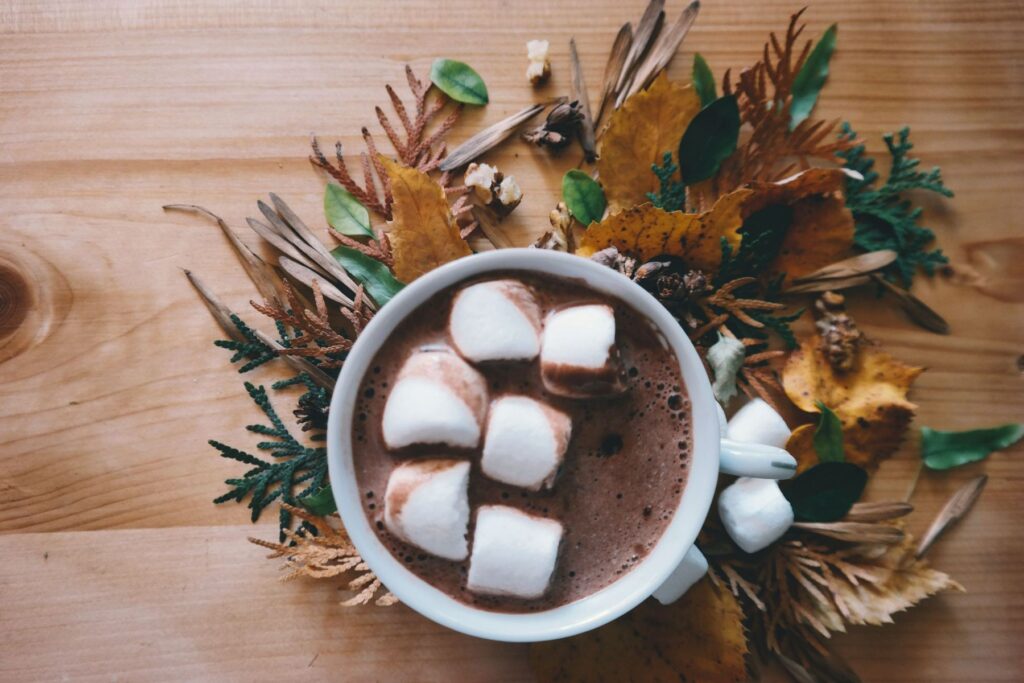
A hot cocoa bar is one of the easiest drinks stations a Christmas host can set up: one pot of cocoa held warm and a table of toppings that guests use to make their own mugs.
Cocoa made with milk scorches when the slow cooker runs too hot, thickens as it sits, and runs out sooner than expected because guests come back for a second mug. Most marshmallows also contain gelatin, which VegNews notes is made from animal skin and bones, so they are not vegetarian.
Plan for second mugs, keep the cooker on warm rather than high and buy gelatin-free marshmallows, and the cocoa itself can be made up to five days ahead, leaving only the reheating and the topping jars for the night.
How much hot cocoa do you need per guest?
Plan on two mugs a person over a two- to three-hour party, and use 8-ounce mugs. Smaller mugs stretch the batch and keep the drink hot to the last sip. A gallon is 16 cups, or 128 fluid ounces, by the National Institute of Standards and Technology’s kitchen conversions, so one gallon fills 16 eight-ounce mugs or about 21 six-ounce cups.
| Guests | Mugs (2 each) | Cocoa to make |
|---|---|---|
| 8 | 16 | 1 gallon |
| 12 | 24 | 1 1/2 gallons |
| 24 | 48 | 3 gallons |
Size the slow cooker to match. Clemson Cooperative Extension advises filling a slow cooker only half to two-thirds full, so a 6-quart cooker holds about a gallon at a time. For 12 or more guests, keep a second batch in the fridge to swap in, or run two cookers.
Hot cocoa or hot chocolate: which should you make?
The two names get used interchangeably, but they are different drinks. Hot chocolate is made from melted chocolate, while hot cocoa starts with cocoa powder and sugar, explains food historian Sarah Wassberg Johnson on her blog, The Food Historian. Cocoa powder is the newer invention. Chocolate was drunk rather than eaten for most of its history, and powdered cocoa dates only to 1828, when a Dutch chemist removed about half the cocoa butter and treated what was left, Smithsonian Magazine reports. Early drinking chocolate was also thicker than modern cocoa, closer to a pudding, as an episode of The New Jersey History Podcast describes.
For a crowd, cocoa powder is the practical choice. It is cheaper by the gallon and holds well. Either type of cocoa works, since there is no baking soda for it to react with: natural cocoa tastes sharper and fruitier, while Dutch-process cocoa is treated to lower its acidity, which makes it darker and mellower, according to Iowa State University Extension’s AnswerLine. Nicole Patel, founder of Delysia Chocolatier in Austin, Texas, told Tasting Table she generally favors Dutch-process for a traditional, smooth cup, since it is mellower and darker and usually dissolves better.
A base recipe that scales
Hershey’s classic hot cocoa is the easiest starting point: 1/4 cup cocoa, 1/2 cup sugar, a pinch of salt and 1/3 cup hot water, boiled for two minutes, then 4 cups of milk and 3/4 teaspoon vanilla, heated without boiling. Multiplied by four for a party, that is 1 cup cocoa, 2 cups sugar, 1 1/3 cups water, a gallon of milk and 1 tablespoon vanilla.
That version is on the sweet side, which suits children. For a darker, less sugary cup, Mississippi State University Extension agent Natasha Haynes uses twice the cocoa (1/2 cup per 4 cups of milk) with 4 tablespoons of brown sugar and a little cinnamon.
Don’t skip the step of cooking the cocoa in water first. Cookbook author Alison Roman writes in her newsletter that “blooming” the powder in boiling water gets rid of its chalky taste. She also makes her cocoa up to five days ahead and rewarms it gently, adding a splash of milk as it thickens.
How to keep hot cocoa warm for a party
Heat the cocoa on the stove first, then transfer it to the slow cooker for holding. The warm setting is meant for holding, not for heating food up, says Alice Moore, a food safety and quality regional agent with the Alabama Cooperative Extension System. To make it in the slow cooker from cold instead, Erin Clarke, the cookbook author behind Well Plated, cooks it on low for two to three hours, whisking about every 45 minutes so the bottom doesn’t scorch, then switches to keep warm. She never holds it on high, because milk can burn or separate.
Cocoa is milk, so treat it like any other buffet dish. The U.S. Department of Agriculture says hot food should stay at 140°F or above, and perishable food should not sit out for more than two hours, because bacteria multiply fastest between 40°F and 140°F. Chill any leftovers within that window. A food thermometer settles it: the FDA warns that some warmers top out at 110°F to 120°F, and recommends swapping in a fresh dish rather than topping up an old one. When the pot gets low, replace it with the second batch instead of pouring new cocoa over the dregs.
Give the pot a stir whenever you pass. The dark sludge that collects in the bottom of a mug is cocoa falling out of the drink as it cools, McGill University’s Office for Science and Society explains, because cooler liquid holds less of it. Warming the mugs with hot water before guests arrive helps too.
What toppings to put out, and how much
Five to eight toppings is plenty; more than that and the line stalls. Cover a mix of textures and flavors:
- Something soft: marshmallows and whipped cream.
- Something crunchy: crushed candy canes, toffee bits or crushed cookies.
- Something to stir in: chocolate chips, caramel sauce, peppermint extract or instant espresso.
- Something to shake: cinnamon, nutmeg or cocoa powder in small shakers.
For a vegetarian bar, buy gelatin-free marshmallows. VegNews lists Dandies, Trader Joe’s and Yummallo among the brands made without it. A kosher symbol is not enough on its own, since The Vegetarian Resource Group points out that some kosher marshmallows still use beef gelatin. A 10-ounce bag of Jet-Puffed minis holds about nine 2/3-cup servings, Kraft Heinz says, or about 6 cups, enough for 30 or more mugs at 3 tablespoons each.
Whip the cream the day before. One cup of heavy cream whips to about two cups and keeps covered in the fridge for up to 24 hours, according to Sally McKenney of Sally’s Baking Addiction; a quick re-whip brings it back. A pint makes about 4 cups, enough for roughly 16 mugs at 4 tablespoons each. Set the bowl inside a bigger bowl of ice on the table, and put it back in the fridge after two hours out.
Flavor ideas, including dairy-free
- Peppermint, cinnamon or mocha: Hershey’s suggests 1/2 teaspoon mint extract or 3 tablespoons crushed peppermint candy, 1/4 to 1/2 teaspoon cinnamon, or 1 to 2 tablespoons instant coffee per batch of its recipe. Put these out as stir-ins so guests choose.
- White hot chocolate: a good second pot for anyone who finds dark cocoa bitter. Tracy of the blog Baking Mischief uses 2 ounces of white chocolate per cup of milk, and recommends a high-quality white chocolate bar or chips.
- Champurrado: the Mexican chocolate drink thickened with masa harina, part of the family of warm corn drinks called atole, as baker Arturo Enciso of Gusto Bread in Long Beach, California, explains for King Arthur Baking. Chef Pati Jinich’s version on GBH serves eight with masa flour, water, milk, Mexican drinking chocolate, brown sugar and a cinnamon stick.
- Dairy-free: make a separate, labeled pot. Chocolatier Hotel Chocolat suggests oat or rice milk for dark cocoa, since both add a little natural sweetness against its bitter edge, and oat is the creamier of the two.
How to set up a grown-up hot cocoa bar
Never spike the main pot. Keep the bottles on a separate tray at the far end of the table, or a side table, with a jigger, so children and drivers can help themselves to cocoa without asking what is in it.
Sonja Overhiser, the recipe developer and cookbook author behind A Couple Cooks, adds about 1 ounce of dark rum, bourbon or Irish cream per mug, or 3/4 ounce of peppermint schnapps. For more choice, Rebecca Frey, a Le Cordon Bleu-trained pastry chef and chocolatier who writes The Chocolate Professor, groups the options by flavor: coffee liqueur, cream liqueur, nutty liqueurs such as amaretto or Frangelico, orange liqueur, and spicy ones. She warns that pouring too much leaves the mug tasting of liquor instead of chocolate.
For reference, one U.S. standard drink is 1.5 ounces of 80-proof spirits, or 2 to 3 ounces of a liqueur at about 24% alcohol, according to the National Institute on Alcohol Abuse and Alcoholism. Spiking cocoa is not new, either: in the Washingtons’ day, drinking chocolate was sometimes made with brandy or wine, according to Mount Vernon. Please enjoy responsibly, and only if you are 21 or over.
How to lay out the table
Set the bar up so people move in one direction: mugs and the cocoa pot first, then stir-ins and shakers, then crunchy toppings, then whipped cream at the end. Put a small plate under the ladle for drips, and spoons and napkins where people finish. If the cooker needs an outlet, place the table against the wall so no cord crosses a walkway.
Label everything, and add allergens to the labels. The FDA names nine major food allergens: milk, eggs, fish, shellfish, tree nuts, peanuts, wheat, soybeans and sesame, it explains. On a cocoa bar that means flagging toffee, peanut butter cups and nut liqueurs, crushed cookies (wheat), and soy in some gelatin-free marshmallows such as Dandies.
A simple timeline keeps the night easy. Make the cocoa up to five days ahead and whip the cream the day before. An hour before guests arrive, rewarm the first batch on the stove, move it to the slow cooker on warm, fill the topping jars and warm the mugs. Keep the second batch in the fridge, ready to heat when the first runs low.
For a first cocoa bar, keep it to one good pot of dark cocoa, a dairy-free pot if anyone needs it, and five toppings, with the bottles off to one side. Hosts who want to go further can add a white chocolate pot or a few of our hot cocktails for cold nights.