A hot cocktail keeps most of its alcohol, whatever the steam coming off the mug suggests. Alcohol takes time to cook off, so a toddy or an Irish coffee built in the mug drinks close to as strong as a cold cocktail with the same pour.
The more common problem runs the other way: the drink isn’t hot enough. A cold mug, room-temperature whiskey and a splash of cream all pull heat out of the water, and bartender and author Jeffrey Morgenthaler has written that the hot toddies served in bars are rarely hot enough.
The fix costs nothing: fill the mug with hot water while the kettle boils, tip it out, then build the drink. Every classic below comes with amounts for one mug, and that warm mug improves all of them.
1. Hot toddy
The toddy is spirit, sweetener and hot water, and its name most likely comes from an Indian word for palm spirits. Difford’s Guide traces the earliest known mention to a British trial record from 1741. The drink took hold in Scotland first and was popular in America by around 1750.
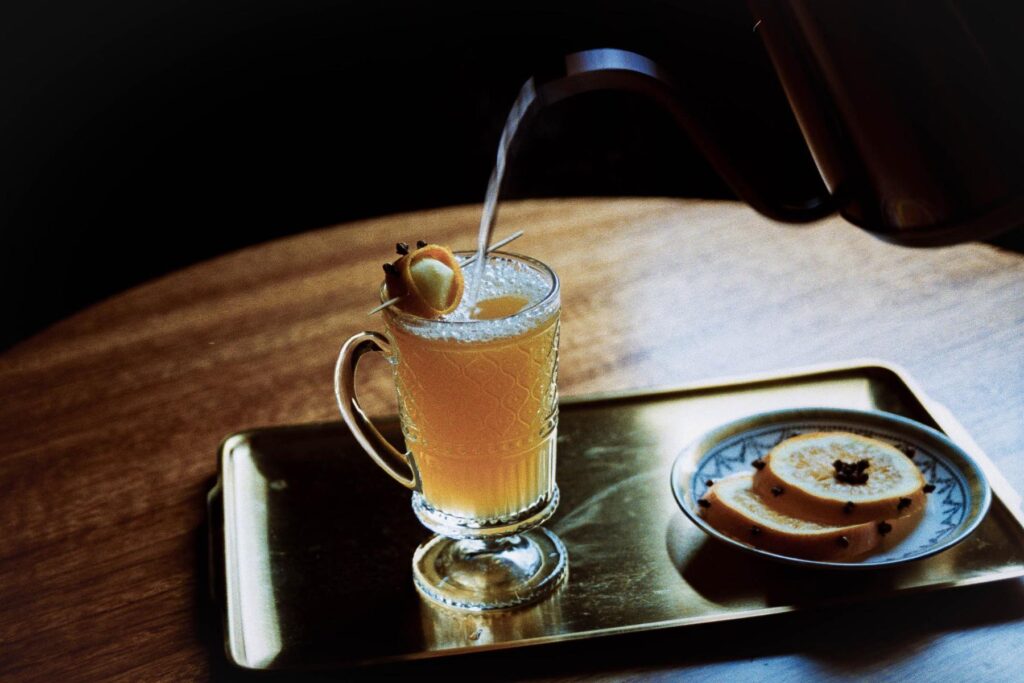
A reliable home spec comes from Julia Tunstall of the cocktail site A Bar Above: 2 ounces of bourbon or cognac, ½ ounce of lemon juice and ½ ounce of honey syrup in a warmed glass, topped with about 3 ounces of hot water and a strip of lemon peel studded with cloves. To make honey syrup, stir honey with an equal amount of hot water so it dissolves instead of sinking.
The YouTube channel How to Drink builds one of its toddies on brewed tea instead of plain hot water. Morgenthaler’s own version swaps the honey for ginger syrup, adds a teaspoon of allspice dram and warms the mixed drink in a tin set inside a second tin of hot water before pouring it into a preheated mug.
2. Irish coffee
The story, as the Foynes Flying Boat Museum tells it, starts on a winter night in 1943, when a flying boat bound for New York turned back to Foynes in the west of Ireland after hours in bad weather. Chef Joe Sheridan added whiskey to the passengers’ coffee, and when one asked whether it was Brazilian coffee, he told him it was Irish.
America got it through San Francisco. In 1952 the owner of the Buena Vista Cafe, Jack Koeppler, and travel writer Stanton Delaplane spent a night trying to copy the version served at Shannon Airport. Their cream kept sinking until they let it age for 48 hours and frothed it to a set consistency. The bar still pours it into a 6-ounce heat-treated goblet.
The Buena Vista method, as CBS Sunday Morning published it: warm the glass with hot water and tip it out, fill it about three-quarters with hot black coffee, stir in 2 sugar cubes until they dissolve and add 1⅓ ounces of Irish whiskey. Lightly whipped heavy cream goes on last, poured over the back of a spoon so it sits on top as a collar.
3. Mulled wine
Germany’s glühwein translates as “glow wine,” and Culture Trip dates the oldest record of it to 1420, a gold-plated tankard a German nobleman owned for drinking spiced wine. Order it “mit Schuss” at a German market and it comes with an extra shot of rum or another spirit. Sweden’s version, glögg, is a Christmas fixture: Swedes get through about 5 million liters of it each Christmas, according to the Stockholm Spritmuseum figures reported by The Local Sweden.
For a basic pot, warm a bottle of fruity, inexpensive red (a Grenache or Zinfandel, nothing oaky) with a sliced orange, 2 cinnamon sticks, 4 cloves, 1 star anise and 2 to 3 tablespoons of honey or sugar, tasting as you go. Never let it boil. Gabriel Corbett, sommelier at the two-Michelin-star restaurant JÔNT, told Food Republic he lets the wine infuse in a slow cooker set to low for 60 to 120 minutes, then moves it to the keep-warm setting, because overheated wine loses alcohol and turns syrupy and raisin-like.
4. Hot buttered rum
Americans were mixing rum and hot water into spiced butter before independence, and most versions today still start from a batter made ahead. Nicole Lebedevitch, who created the hot buttered rum at the Boston cocktail bar The Hawthorne, shared her recipe with Punch. She beats butter, brown sugar, honey, spices and softened vanilla ice cream together, then builds each drink from 1 tablespoon of batter, 2 ounces of dark rum and 4 ounces of hot black tea, pouring half the tea in before the rum and half after.
One check for vegetarians: some supermarket vanilla ice creams contain gelatin, so read the label before it goes into the batter.
5. Tom and Jerry
The Tom and Jerry is a hot, frothy cousin of eggnog. Bartender Jerry Thomas claimed he invented it in 1847 and named it after his two white mice, a claim Punch calls a tall one. Drinks historian David Wondrich ties the name instead to Pierce Egan’s 1821 London work Tom and Jerry, in which a rowdy night on the town was called “Tom and Jerrying.”
Punch’s recipe comes from Seattle bartender Andrew Bohrer. The batter: 12 eggs, separated and beaten, with 1 cup of superfine sugar, a stick of butter and a teaspoon each of allspice, cinnamon, cloves and vanilla. Each mug gets a tablespoon of batter, 1 ounce of brandy and 1 ounce of aged rum, topped with warm milk or hot water and a grating of nutmeg.
It became a Wisconsin staple, which Jim Draeger, author of a book on Wisconsin’s historic taverns, puts down to the state’s taste for brandy and its dairy industry, Atlas Obscura reports. Milk-glass Tom and Jerry bowl-and-mug sets from Hazel-Atlas and McKee Glass were common from the 1940s through the 1960s.
The eggs in the batter are never cooked, and an FDA article republished by Food Safety News warns that alcohol can’t be counted on to kill salmonella in raw-egg drinks. Use pasteurized eggs, which some supermarkets sell for a little more than regular eggs.
6. Spiked hot cider
Hot apple cider takes almost any brown spirit, but apple brandy is the natural match. New Jersey’s Laird & Company comes from a family that supplied applejack to George Washington’s troops, according to Difford’s Guide. Its Bottled in Bond is all apple brandy aged at least four years, while the blended applejack is 35% apple brandy and 65% neutral grain spirit. For cider, the bonded bottle is our pick.
Warm 6 ounces of fresh cider with a cinnamon stick until it steams, pour it into a warmed mug and stir in 1½ ounces of apple brandy, bourbon or dark rum. A strip of orange peel is the only garnish it needs.
7. Spiked hot chocolate
Charles Joly, a James Beard Award-winning bartender and co-founder of Crafthouse Cocktails, pairs aged rum with coffee liqueur in a recipe for Williams Sonoma. He warms 12 ounces of milk or oat milk with 1 ounce of aged rum and ¾ ounce of coffee liqueur until hot but not boiling, then adds spiced drinking chocolate and a pinch of salt and froths it.
8. Café brûlot
Café brûlot is a tableside drink at Antoine’s in New Orleans, where it’s credited to Jules Alciatore, son of the restaurant’s founder. A server sets brandy alight in a silver bowl and ladles the flames down a curl of orange peel studded with cloves before hot chicory coffee is poured into the bowl. Flaming spirits in a home kitchen are a burn risk, so this is one to order rather than make.
Does the alcohol cook off in a hot cocktail?
Most of it stays. Ethanol boils at about 173°F, well below water’s 212°F, according to NOAA’s chemical data sheet, so it does leave a hot pot faster than water, but slowly. A sauce brought to a boil and taken off the heat keeps about 85% of its alcohol, a flamed dish keeps 75%, and food cooked for an hour keeps about a quarter, Idaho State University registered dietitian Barbara Gordon writes, citing USDA data for the timed figures.
For a single mug, the spirit goes in at close to full strength. A pot of mulled wine loses more alcohol the longer it’s held hot, so keep it below a simmer and add any extra spirit shortly before serving.
How hot should a hot cocktail be?
A study of drinking temperatures in the journal Burns found coffee, tea and cocoa are often served at 160°F to 185°F, high enough to cause a scald with brief contact, and calculated that about 136°F is the best temperature for drinking. Starting with water off the boil and a warmed mug leaves room for the room-temperature spirit and lemon to bring a toddy down toward that range. Give it a minute before the first sip.
Use heavy ceramic mugs or glasses sold as heat-resistant. Thin everyday glassware can crack when boiling water hits it.
How to keep hot drinks warm for a party
A slow cooker is the easiest way to hold cider, cocoa or mulled wine for a crowd, but it shouldn’t do the heating. Clemson University’s food safety extension advises bringing food to a steaming 165°F on the stove first, then moving it to a slow cooker preheated to 140°F or above. That includes a pot of cocoa made with milk.
Keep the spirit out of the pot when you can. A warm base of cider, cocoa or tea on low, with a bottle and a jigger beside it, keeps every mug at full strength and lets anyone not drinking share the same pot.
Lighter and alcohol-free versions
In the US a standard drink is 1.5 ounces of 80-proof liquor, according to the National Institute on Alcohol Abuse and Alcoholism, so a 2-ounce toddy is about one and a third drinks, and the Tom and Jerry above is the same. For a lighter mug, cut the pour to 1 ounce and top up with more tea, cider or coffee.
For no alcohol at all, A Bar Above suggests leaving the spirit out of the toddy, which leaves hot honey and lemon, or using a nonalcoholic spirit such as Seedlip. Hot cider with a cinnamon stick and a good hot chocolate need nothing added.
For a first attempt, start with the toddy: four ingredients, a kettle and a warmed mug. The Tom and Jerry is the one to save for a party, since the batter is made ahead and each mug takes a spoonful.
Please enjoy responsibly.