A vegetarian Christmas main has one job the side dishes don’t: it has to look like it belongs in the middle of the table. The dishes that manage it share a few traits. They come out of the oven whole, they slice into neat portions, they feed a full table, and they carry enough protein to count as dinner.
Vegetarian guests are a regular part of many holiday tables. In a Gallup poll, women were three times as likely as men to say they eat a vegetarian diet. The catch is that many holiday recipes hide animal products in the cheese, the stock or the pastry.
The twelve mains below run from showpiece Wellingtons to bakes you can finish days ahead. Each comes with its cook time, how many it feeds and how far ahead you can make it, so you can pick one that fits both your oven and your schedule.
What makes a vegetarian main feel like the centerpiece?
Deb Perelman, the cookbook author behind the food site Smitten Kitchen, puts the test simply on her leek and white bean galette recipe: a meatless main shouldn’t just be a plate of the sides everyone else is eating, and ideally it brings its own protein. Beans, lentils, nuts, eggs and cheese do that work in most of the dishes below.
Presentation matters as much as protein. Tanya Sichynsky, a senior staff writer at NYT Cooking who writes its vegetarian newsletter, told WNYC’s All Of It that affordable store-bought puff pastry gives a vegetable dish wow factor, and that a filling served inside a hollowed-out half butternut squash makes for a striking presentation. Pastry, a whole roasted vegetable or a tall layered bake gives the table the same focal point a roast would.
1. Lentil and mushroom Wellington
This is the closest thing to a classic holiday roast, and the most dramatic of the twelve. Nisha Vora, the cookbook author and YouTuber behind Rainbow Plant Life, wraps a log of lentils, mushrooms, toasted walnuts and miso in puff pastry in her vegan Wellington. It bakes at 375°F, then finishes at 425°F for a deep golden crust.
Time and servings: about 2 1/2 hours, serves 8. Make ahead: bake the filling log or assemble the whole Wellington one to two days early; the baked log freezes for a few months.
2. Beet Wellington
Slice into this one and the deep red center looks startlingly like a rare roast, which makes it the party trick of the list. Sarah Bond, who holds a nutrition degree and runs the recipe site Live Eat Learn, simmers whole beets in water and balsamic vinegar, then wraps them in puff pastry with a ricotta and mushroom pâté in her beet Wellington.
Time and servings: about 1 1/2 hours, serves 5. Make ahead: cook the beets and mushroom layer two days early; the wrapped Wellington can wait in the fridge for up to 8 hours before baking. Double it for a bigger crowd.
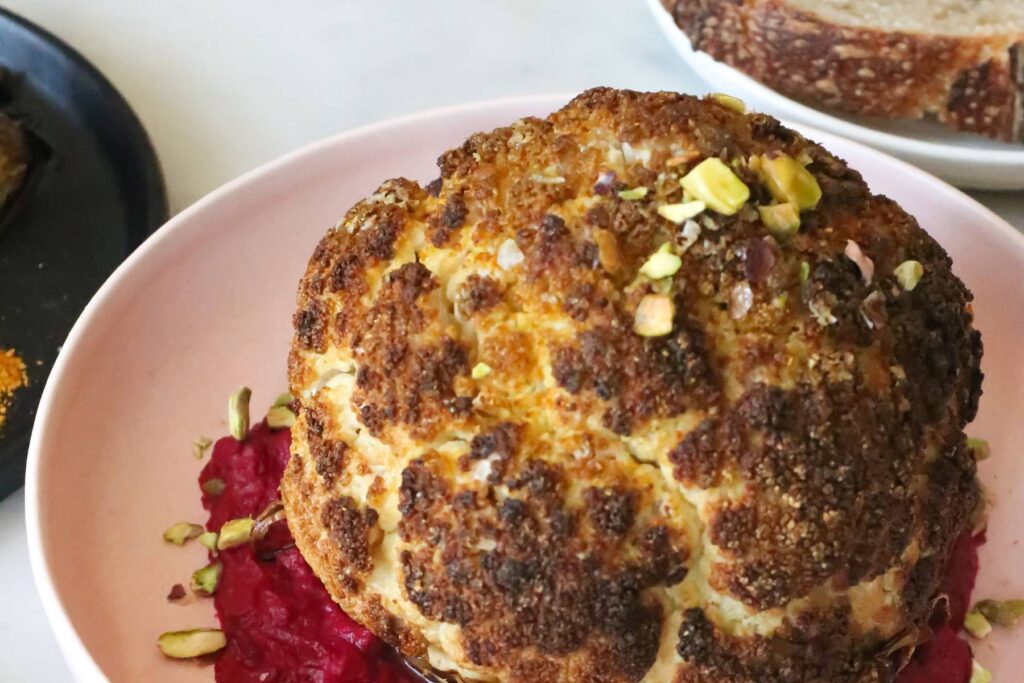
3. Whole roasted cauliflower with harissa
A whole head of cauliflower, browned and glossy, carves at the table like a small roast. Jeanine Donofrio, the cookbook author behind the vegetarian site Love and Lemons, coats hers in harissa and roasts it in a cast-iron skillet at 425°F, first covered with foil for 30 minutes so the inside steams tender, then uncovered for about 30 more to brown, in her whole roasted cauliflower.
Time and servings: about 1 1/4 hours, serves 4. Make ahead: best roasted the day you serve it. Roast two heads for eight people and add a spoonful of white beans or a lentil salad alongside for protein.
4. Chestnut and quinoa nut roast
Nut roast is the old-school British answer to a vegetarian Christmas, and chef and TV cook Jamie Oliver’s version from his Christmas cookbook updates it with chestnuts and quinoa, then finishes it in a tomato sauce warmed with cinnamon and chili. The recipe is published on the cookbook site The Happy Foodie.
Time and servings: about 1 3/4 hours, serves 8. Make ahead: the site suggests freezing it before baking, so it can be done weeks ahead and baked on the day.
5. Squash, lentil and date nut roast
For a sweeter, more autumnal loaf, Adam Bush, deputy food editor at olive magazine, combines squash, lentils and dates under a crunchy pecan and sage topping glazed with honey in his Christmas nut roast. There’s no cheese in it, which makes it one of the easiest picks if a guest avoids dairy.
Time and servings: about 2 hours, serves 6. Serve with: a vegetable-stock gravy or a cranberry sauce, which suits the dates.
6. Butternut squash lasagna
Lasagna turns up on almost every vegetarian holiday menu because it feeds a crowd and holds well, and this version looks the part for December. Alexandra Stafford, the cookbook author behind Alexandra’s Kitchen, layers roasted butternut squash with noodles and finishes the top with salted whipped cream in her butternut squash lasagna.
Time and servings: about 1 1/2 hours, serves 8 to 10. Make ahead: assemble up to 24 hours early, or bake, cool and freeze for up to 3 months, then reheat at 350°F. Use a Parmesan-style cheese made with vegetarian rennet (more on that below).
7. Mushroom bourguignon
This version of the French beef stew is built on mushrooms and red wine. Steve Dunn, a recipe developer at America’s Test Kitchen, adds dried porcini to his mushroom bourguignon for a savory, meaty base, and the recipe is fully plant-based. America’s Test Kitchen suggests serving it over polenta, buttered noodles or mashed potatoes.
Time and servings: about 1 3/4 hours, serves 6 to 8. Why it works: it lives on the stovetop, which leaves the oven free for everything else.
8. Butternut squash and caramelized onion galette
A free-form tart is easier than a pie and looks more rustic and generous. Perelman’s butternut squash and caramelized onion galette uses a flaky dough made with sour cream and lemon, filled with roasted squash, slow-cooked onions and fontina (choose one made with microbial rennet).
Time and servings: about 2 hours, serves 6 to 8. Make ahead: bake it fully and reheat, or keep the dough and filling separate in the fridge and assemble just before baking.
9. Spanakopita
A big tray of Greek spinach and feta pie, shattering phyllo on top, feeds a crowd and travels well to a buffet table. Suzy Karadsheh, founder of The Mediterranean Dish and a best-selling cookbook author, packs her spanakopita with two full bunches of parsley, and she suggests keeping some of the stems for extra flavor.
Time and servings: about 1 1/4 hours, 12 pieces. Make ahead: assemble and refrigerate overnight, then bake. Check that the feta is made with microbial rennet. Single pieces freeze; reheat until the center reaches 165°F.
10. Stuffed acorn squash
Halved acorn squash makes a ready-made serving bowl, so every guest gets their own little centerpiece. Kathryne Taylor, the cookbook author behind the vegetarian blog Cookie and Kate, fills hers with quinoa, dried cranberries and pepitas in her vegetarian stuffed acorn squash, which looks right at home next to the holiday reds and greens.
Time and servings: about 1 hour, 4 halves (double it for eight). Make ahead: one reader in the comments stuffed the squash the day before, chilled it overnight and gave it about 20 minutes in the oven to heat through. The filling uses Parmesan, so swap in a vegetarian hard cheese.
11. Eggplant Parmesan
For an Italian-American Christmas, eggplant Parmesan is a familiar crowd-pleaser. Nicole Konstantinakos, a recipe developer at America’s Test Kitchen, skips the frying in her classic eggplant Parmesan: the slices roast unbreaded at 450°F, so there’s no pan of hot oil to manage.
Time and servings: about 1 3/4 hours, serves 8. As with the lasagna, choose a hard cheese made with vegetarian rennet.
12. Lentil and mushroom shepherd’s pie
This is the most budget-friendly main on the list. Beth Moncel, the recipe developer who founded Budget Bytes, builds her vegetarian shepherd’s pie on lentils and mushrooms under a mashed potato lid, and prices the whole dish at under $6 at the time of writing.
Time and servings: about 1 hour, serves 6. Make it festive: Moncel swirls the potatoes with a spoon and offers an optional few minutes under the broiler to brown the top.
How far ahead can you make a vegetarian Christmas main?
Most of these can be largely done before Christmas Eve. The USDA’s leftovers guidance says cooked food keeps three to four days in the fridge and three to four months in the freezer, should go into the fridge within 2 hours of cooking, and should be reheated to 165°F.
- Freeze weeks ahead: the nut roast (unbaked), the Wellington filling log, the baked lasagna and spanakopita pieces.
- Make one to two days ahead: the lentil Wellington (assembled), the beet Wellington’s beets and mushroom layer, the galette dough and filling, the lasagna (assembled, unbaked).
- Make on the day: the whole roasted cauliflower and the eggplant Parmesan, which come with no make-ahead instructions from their recipe developers.
Puff pastry needs the most care. The Pepperidge Farm puff pastry site advises thawing sheets at room temperature for no more than 40 minutes, or about 4 hours in the fridge, and keeping the dough cold until it goes in the oven. Thawed pastry can be chilled again but not refrozen, so wrap the Wellington the day you plan to chill it.
Which ingredients aren’t vegetarian?
A dish made with no meat can still be off-limits for a vegetarian guest. These are the usual culprits in holiday cooking:
- Parmesan and some other hard cheeses: the Vegetarian Society notes that true Parmigiano Reggiano is made with calf rennet and that Gorgonzola usually isn’t vegetarian either. Look for “microbial,” “plant” or “thistle” rennet on the label, and be wary of “rennet,” “pepsin” or “animal enzymes.”
- Worcestershire sauce: the original Lea & Perrins recipe lists anchovies, so use a vegetarian Worcestershire or a splash of soy sauce in gravies and stews.
- Store-bought pie crust: some refrigerated crusts are made with lard, including Pillsbury’s refrigerated pie crust. Check the label, or use an all-butter crust.
- Stock and gravy: stuffing, gravy and risotto are often made with chicken or beef stock. Make a separate vegetable-stock gravy for the vegetarian main and label it on the table.
Store-bought puff pastry is often fine: Pepperidge Farm’s sheets are made with vegetable oil rather than butter or lard, according to the ingredient list at the time of writing. That also makes them a good pick for a guest who doesn’t eat dairy.
Will a vegetarian main fill people up?
It will if it carries protein, which is why lentils, beans and nuts show up so often in this list. Harvard’s Nutrition Source puts a cup of cooked lentils at about 18 grams of protein and an ounce of almonds at about 6 grams. The Wellingtons, nut roasts and shepherd’s pie are the most filling; with the cauliflower or the galette, add a bean dish or a cheese board to the spread.
Plan for meat eaters to take some too. A Wellington or lasagna that serves eight is a safer size than a single-serving stuffed squash, even if only one or two guests are vegetarian.
How to share the oven with a Christmas ham
A fully cooked ham only needs reheating, and the USDA’s ham guidance calls for an oven of at least 325°F, until the ham reaches 140°F (165°F if it was repackaged outside a USDA-inspected plant), which takes about 10 minutes per pound for a spiral-cut ham and 15 to 18 minutes per pound for a whole bone-in ham.
A 325°F oven also suits several of these mains. Reheat the lasagna, shepherd’s pie or spanakopita on the rack below the ham at the same temperature. Save the pastry mains, which need 375°F to 425°F to puff, for the stretch after the ham comes out and rests under foil. If you have just one oven and want zero juggling, the mushroom bourguignon cooks entirely on the stovetop.
For a first try, the lentil and mushroom Wellington gives the most show for the effort, and it can be assembled two days out. If the week is already full, the butternut squash lasagna is the safest bet: it freezes, reheats alongside the ham and feeds the whole table.
Lead photo: Geraud pfeiffer / Pexels