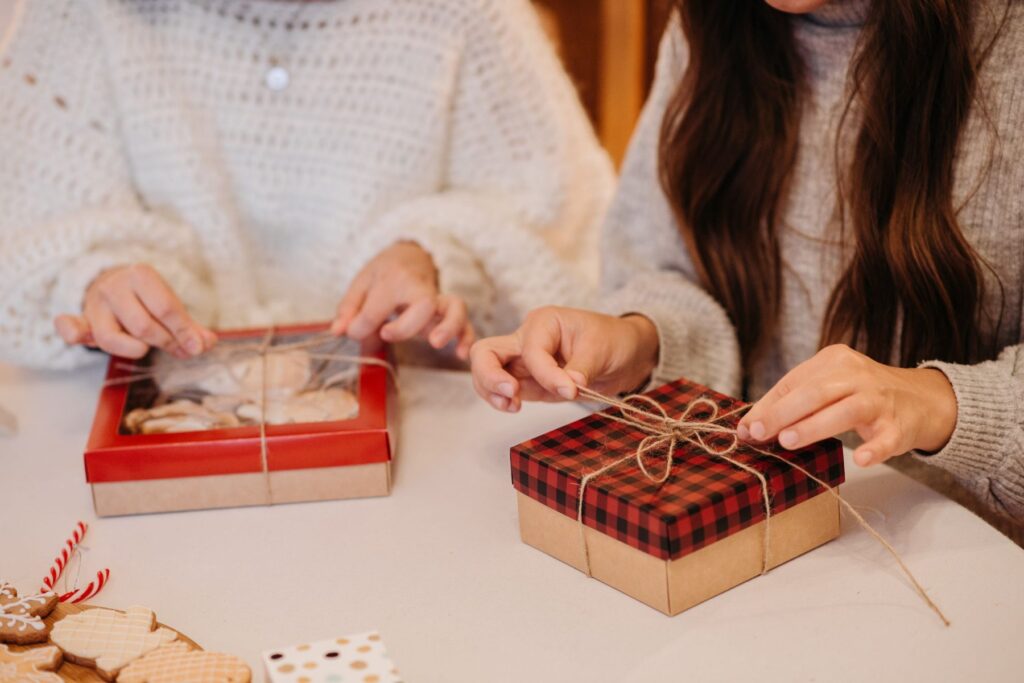
A cookie swap turns one big batch of baking into a box of many different cookies, which makes it one of the easiest holiday parties to host. Each guest bakes a single recipe in bulk, everyone trades, and the host mostly supplies the table, the boxes and something warm to drink.
Most cookie swap problems start in the planning. A guest list too long for the table, duplicate batches of chocolate chip, cookies that crumble on the drive home or need fridge space nobody has: each problem is avoidable with a sign-up sheet and a little arithmetic.
Get those details right and every guest leaves with a mixed box that keeps well past Christmas, with plenty left over to freeze for January.
How does a cookie swap work?
Each person bakes several dozen of one kind of cookie and brings them to the party. The cookies are laid out by type, and guests work their way around the table with an empty box, taking a share of each batch. Lauren Chattman, a former professional pastry chef in Sag Harbor, New York, and the author of the book Cookie Swap!, told The Atlanta Journal-Constitution that everyone brings the same number of cookies and takes the same number home, just in many more flavors.
The party itself is an old American habit. In November 1960, Washington’s Evening Star newspaper was already declaring that “Cookie Swaps are Sweeping the Country,” as the Library of Congress points out in a post on holiday cookie parties.
How many people should you invite?
Fewer than most hosts expect, because adding guests adds varieties, not cookies per person. The real limit is space. Chattman’s advice to the Atlanta Journal-Constitution is to invite only as many people as your table can comfortably hold.
Hetal Vasavada, a cookbook author (Milk and Cardamom and Desi Bakes) and former MasterChef contestant, puts a number on it on the Dinner Party Podcast: allow about a foot of counter or table per baker. Her own setup, a 12-foot island plus a six-by-three-foot table, fits around 15 people.
In most homes, six to 12 guests is the sweet spot. Six already gives a box with real variety. Past a dozen, the swap needs a second table and a helper, and costs start to add up. For a group that size, cookbook author and King Arthur Baking contributor Sarah Copeland suggests asking each guest to chip in $5 to $10 for boxes, drinks and serveware.
How many cookies should each person bring?
Start with how many cookies each guest should take home of every kind, then multiply. Half a dozen of each is generous; three or four is plenty for a big group. The formula is:
Cookies per baker = number of guests x cookies each guest takes of each kind, plus one dozen for tasting at the party.
- 6 guests taking 6 of each: 36 cookies plus a tasting dozen, so 4 dozen per baker.
- 8 guests taking 6 of each: 48 plus a tasting dozen, so 5 dozen per baker.
- 12 guests taking 4 of each: 48 plus a tasting dozen, so 5 dozen per baker.
Chattman’s own guide is to bake as many cookies as you plan to take home, which she puts at four to five dozen, in line with the formula. For a casual party that is more about tasting than taking home, Vasavada asks for just two cookies per guest.
Put the final number on the invitation, along with a request for small cookies. Three-inch cookies stretch further than oversized bakery-style ones, and they fit in a box.
When to hold it, and when to send invitations
Early December is the natural window: late enough to feel festive, early enough that the cookies last until Christmas and nobody has left town yet. A weekend afternoon works best, because it needs no meal. Chattman recommends settling the guest list at least a couple of weeks ahead, and sending invitations three to four weeks out is safer in December, when calendars fill fast.
A planning timeline:
- Three to four weeks out: send invitations with the date, the number of cookies to bring and an RSVP deadline.
- Two weeks out: close the sign-up sheet so every recipe is different.
- One week out: send a reminder with the final head count, so bakers can adjust their batch.
- One to two days out: bakers bake. The host sets up boxes, labels and the table.
- On the day: about two hours of swapping, tasting and talking is plenty.
Use a sign-up sheet
A shared sign-up sheet stops duplicate batches. Vasavada collects allergy information with the RSVPs, then sends around a sign-up sheet so no two people bring the same cookie. A shared document or spreadsheet with three columns (name, cookie, main allergens) does the job, and it doubles as the list for printing labels later.
The sign-up sheet also flags allergies early. Vasavada’s advice is for the host to bake one batch that suits any guest with a dietary restriction, so nobody leaves with an empty box.
The invitation is also the place to set house rules. Decide whether store-bought cookies are welcome (a kind option for guests who don’t bake), whether brownies and fudge count, and whether the cookies should arrive on a platter or boxed in portions.
Which cookies travel and keep best
The best swap cookies survive a car ride and a week on the counter. In King Arthur Baking’s guide to shipping cookies, longtime King Arthur baker and writer PJ Hamel names the sturdy types that hold up: small cookies, dry biscotti that stay crisp for weeks, thick and moist bars and brownies, sandwich cookies held together by their filling, and cutouts rolled a little thicker. The ones that suffer are delicate cookies such as pizzelles and Florentines, thin cutouts, and bars half an inch thick or less, which go stale quickly.
Good choices for a swap:
- Sturdy bars and brownies, such as blondies: cut cleanly and stack. Lemon and cheesecake bars need the fridge, so they stay home.
- Shortbread and slice-and-bake cookies: firm and long-keeping.
- Biscotti and gingersnaps: dry cookies made to last.
- Crinkles and thumbprints: sturdy, and they look festive in a mixed box.
Two kinds are better kept for home. Meringues pull moisture out of the air, so they turn sticky and soft in a humid kitchen, according to King Arthur Baking’s guide to storing meringues. And anything with cream frosting, a cheese filling or custard, along with no-bake cookies, belongs in the fridge, says Susan Glassman, a nutrition and wellness educator with University of Illinois Extension. Cookies that need refrigeration are a poor fit for a table that sits out all afternoon.
Labels, allergens and recipe cards
Every batch needs a label with the cookie’s name, the baker and its main allergens. The FDA lists nine major food allergens: milk, eggs, fish, crustacean shellfish, tree nuts, peanuts, wheat, soybeans and sesame, which became the ninth in 2023. In a cookie swap, the ones that matter most are usually nuts, wheat, eggs, milk and sesame.
Labels matter because some food allergies can be life-threatening. Martin Bucknavage, a senior food safety extension associate at Penn State’s College of Agricultural Sciences, advises marking nut cookies clearly, and he points out that snacking on peanuts while baking can carry the allergen onto cookies that contain none.
At the table, Vasavada lines the surface with brown parchment marked into sections, one for each cookie, with its name and allergens written on the paper. Nut cookies are best placed at one end with their own tongs. Recipe cards are a tradition at most swaps, and handwritten ones make a nice keepsake tucked into each box. Vasavada’s shortcut is one shared document of recipe links sent around after the party.
Boxes, bags and the table
Bakery boxes beat cookie tins for a mixed haul, Vasavada says: an 8-inch square bakery box lets cookies lie flat and still has room for puffier ones, while tins can be too small. A sheet of parchment between layers keeps frosted cookies from sticking to plain ones. Have guests bring a container of their own as a backup.
A small packing station at the end of the table saves a lot of shuffling: the boxes, parchment or waxed paper, paper muffin liners for fragile cookies, ribbon or twine, scissors, a marker for names and the printed labels.
Set the cookies out in a single line or around the edge of a table, so people can move along it in one direction. A tasting plate of each kind on a separate table keeps the swap batches intact. A few sprigs of greenery, a string of lights and a cake stand or two are all the decorating the table needs.
When everyone has arrived, explain how the swap works before anyone picks up a box: how many of each cookie to take, that tasting happens at the tasting table, and that guests take turns rather than crowding one platter. Going around in order of arrival keeps it fair, and a second lap for any leftovers settles the rest.
What to serve at a cookie swap
Keep the menu light, since the cookies are the main event. Tessa Arias, the baker behind the blog Handle the Heat, suggests coffee, tea, hot cocoa, milk and eggnog, with wine or spiked eggnog and a vegetable platter as optional extras. Vasavada’s rule is to serve real food if the party runs through a mealtime, so guests don’t have to leave early: a light casserole, plus a cheese board to balance the sweets.
A little friendly competition is optional. Arias suggests taste-test ballots with judging categories, and prizes such as a cookbook, a cookie jar or an apron. Vasavada’s advice is to hold a vote only if the group can handle losing.
How long do swapped cookies keep?
Homemade cookies keep two to three weeks at room temperature in an airtight container, according to Iowa State University Extension’s AnswerLine, which also advises storing crisp and chewy cookies in separate containers so the crisp ones don’t soften. Moist bars such as lemon bars belong in the fridge, where they last up to a week.
For longer storage, freeze them. Baked cookies keep up to six months at 0°F, according to Michigan State University Extension, which recommends freezing frosted cookies uncovered on a tray until firm, then packing them, and labeling every container with the date and the cookie. Carla Hadley, a Miller County Extension agent with the University of Arkansas System Division of Agriculture, suggests freezing cookies unfrosted, since frosted cookies can turn moist under the frosting, and thawing them loosely covered on a serving plate for about 20 minutes.
Can you make the dough ahead?
Yes, and it takes most of the pressure off the week of the party. Michigan State’s advice is to drop unbaked cookie dough onto baking sheets, freeze it until solid, then move it to freezer bags or airtight containers. The dough is ready to bake whenever the week allows, rather than all at once the night before.
Resist tasting as you go. Raw flour comes from untreated grain and can carry E. coli, the FDA warns, and baking is what makes it safe.
What to do with leftover cookies
A big swap almost always ends with extras. Food banks generally can’t accept food made in a home kitchen, because it isn’t sealed and its ingredients can’t be checked, Feeding America explains. Rules at shelters, churches and meal programs vary, so call ahead before packing anything up.
Mailing them to family is the other option. Hamel’s shipping advice is to seal cookies in airtight bags no more than two layers deep, pack them with bubble wrap so nothing rattles, and send them early in the week so the box doesn’t sit in a warehouse over the weekend. The USPS posts holiday send-by dates each fall. For the lower 48 states, the cutoffs for Christmas delivery usually fall in the week before the holiday, a day or two later for Priority Mail and Priority Mail Express than for Ground Advantage, so check the page before baking for the post.
An office or neighborhood version
The same plan works outside a living room. For an office swap, a conference room table and a lunchtime slot replace the afternoon party, and pre-bagged portions are easier than open platters. For neighbors who can’t all be home at once, a drop-off swap works too: each baker leaves boxed portions on the host’s porch by a set time, and the host sorts them into mixed boxes for collection.
The two things to settle first, whatever the setting, are the head count and the sign-up sheet. With those in hand, the rest of a cookie swap is mostly boxes, labels and a pot of coffee, and every guest goes home with a better holiday cookie box than one person could bake alone.