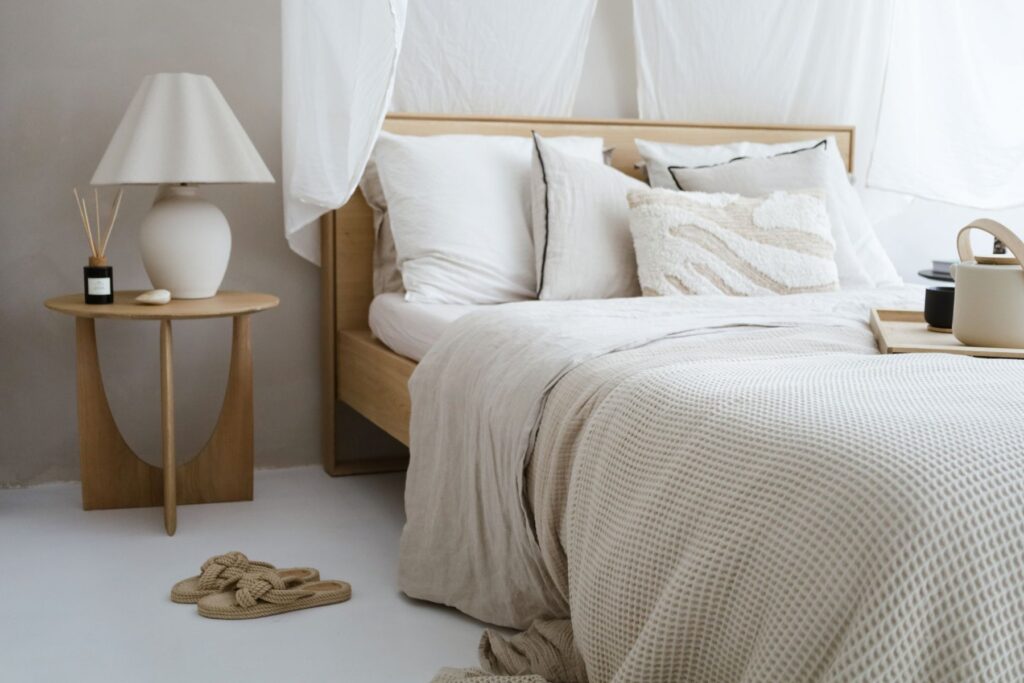
The bed decides most of what a visitor thinks of a guest room. The mattress, the pillows and how warm the room stays overnight shape whether a guest sleeps well, and they count for far more than the decor.
Hosts rarely find out how their room performs. Guests tend to stay quiet about a sagging mattress or a drafty window, and in a survey by mattress brand Amerisleep, about a third of the hosts who had tried sleeping in their own guest setup gave up before morning.
Most of the fixes cost little or nothing. A night in the room yourself, a hot wash of the bedding and a look at the thermostat solve most of what keeps guests awake, and everything below fits into the week before anyone arrives.
1. Sleep in the guest room yourself first
The most useful test takes one night. Novelist Marie Bostwick, who hosts regularly at her home in Central Oregon, writes on her blog that she sleeps in her own guest room once or twice a year, because guests seldom mention what’s wrong.
Go to bed at the time a guest would and note everything that bothers you: a draft from the window, a streetlight through the curtains, a lamp you can’t reach from the pillow, no free outlet near the bed, a clanking radiator or a furnace you can hear. Each of those is a quick fix once you know about it.
2. Test the smoke and carbon monoxide alarms
A spare room or home office that nobody usually sleeps in is easy to overlook. The U.S. Fire Administration says smoke alarms belong inside every bedroom, outside each sleeping area and on every level of the house. Test them once a month, and replace any alarm 10 years after its manufacture date.
Carbon monoxide alarms matter as much in winter, when furnaces and fireplaces are running. The Consumer Product Safety Commission recommends one on every level and outside sleeping areas, with a battery backup so it keeps working in a power outage.
3. Wash everything, even the clean linens
Sheets that have sat folded in a closet since the last visit can smell stale and collect dust. The Asthma and Allergy Foundation of America advises washing sheets and blankets in water of at least 130°F to deal with dust mites, using zippered allergy covers on the pillows and mattress, and replacing pillows about every two years. Wash the throw and the curtains too if they have been hanging all year, and dust, vacuum under the bed and wipe the mirror and windows the same week.
Pets need planning further ahead if a guest is allergic. Sandra Hong, MD, an allergist at Cleveland Clinic in Ohio, told the clinic’s newsroom that cat allergen can linger for up to four months, while dog allergen fades faster, and that keeping pets out of bedrooms and off upholstered furniture helps. In practice, shut the dog or cat out of the guest room for as long as you can before the visit.
If several groups are coming between Thanksgiving and New Year’s, the design studio Michelle Gage Interiors suggests in its newsletter keeping at least two matching sets of sheets and towels, so the room can be turned around without waiting on the dryer.
4. Get the mattress and pillows right
Firmness is the first thing to check. Andrew Bang, DC, a chiropractor at Cleveland Clinic in Ohio, said on the clinic’s Health Essentials podcast that medium-firm is the usual recommendation, and that a topper can make a firm mattress softer but can’t make a soft one firmer. So a too-hard guest bed is a cheap fix, while a sagging one usually means a new mattress or a different bed for the guest. Put a waterproof mattress protector under the sheets either way.
For pillows, AARP’s etiquette column suggests two per guest plus spares. Make one of each pair firmer and one softer, because back, side and stomach sleepers want different heights. The Global Wellness Institute’s sleep guide for hotels recommends offering that kind of choice by sleep position, and keeping sheet thread counts under 600 so the bedding breathes.
Cotton percale is the safe choice for sheets: crisp, cool and easy to wash hot. Bostwick prefers organic cotton percale and steers clear of sateen unless you live somewhere cold.
5. Layer the bed and set the thermostat
Temperature tops the list of guest complaints. In the Amerisleep survey, a cold room was the complaint hosts heard most (27%), ahead of a hot room (20%). The Sleep Foundation puts the best bedroom temperature at 65 to 68°F for most people.
Older guests may want it warmer. A study of about 11,000 nights of sleep in 50 older adults, led by Amir Baniassadi, PhD, of Hebrew SeniorLife’s Marcus Institute for Aging Research and Harvard Medical School in Boston, found they slept most efficiently between 68 and 77°F, Sleep Review reported, with wide differences from person to person.
Since nobody agrees on the right number, build the bed in layers a guest can adjust alone: a flat sheet, a light blanket, a duvet, and a throw folded at the foot. Leave a spare blanket where they can see it, so they never have to ask.
If the room needs a space heater, follow the CPSC’s winter rules: keep it at least 3 feet from bedding, curtains and furniture, plug it straight into a wall outlet rather than an extension cord, and turn it off before sleep. Portable heaters are involved in about 1,600 home fires a year, the agency says, so warming the room before bedtime is safer than running one all night.
6. Make the air mattress or sofa bed worth sleeping on
Plenty of guests end up on the couch. Among people who host without a guest room, 56% put visitors there, according to a Talker Research survey for Avocado Green Mattress.
If you use an air mattress, a double-height one is easier to get in and out of, especially for older guests, according to Consumer Reports testing covered by KSAT, in which one model sank almost 6 inches under weight. Inflate it the day before and leave it overnight to catch a slow leak, put a rug or blanket underneath against a cold floor, and top it up just before bed. On a pull-out sofa, a topper or a folded duvet over the mattress hides the bar.
7. Darken the room and light the way to the bathroom
In a study led by Phyllis Zee, MD, chief of sleep medicine at Northwestern University’s Feinberg School of Medicine in Chicago, one night in moderate room light, compared with a dim room, raised heart rate during sleep and left people more insulin resistant the next morning, the university reported. Zee’s advice is blackout shades or an eye mask, and a dim amber or red night-light kept low to the floor.
That same night-light helps a guest find the bathroom in a house they don’t know. The CDC’s home fall-prevention checklist calls for a lamp within easy reach of the bed and a night-light so you can see where you’re walking. Lighting the route matters most for older guests: about 1 in 4 older adults report a fall each year, according to the CDC. Clear cords and loose rugs from the route as well.
Noise matters too. Researchers at Brown University found that on a first night somewhere unfamiliar, one side of the brain stays more alert during deep sleep and reacts more to unexpected sounds, an effect that had gone by the second night, said Yuka Sasaki, a research associate professor at Brown in Providence. A white noise machine can mask a creaking house, though the evidence that steady noise improves sleep is rated very low quality in a systematic review in the journal Sleep Medicine Reviews. If you leave one out, the Sleep Foundation suggests starting with it in a corner of the room, at about the volume of a background conversation.
8. Put the essentials within reach
Guests rarely like to ask for basics. AARP lists a card with the Wi-Fi details, a flashlight in the nightstand, outlets that are easy to reach (or an extension cord where they’re hidden), and at least one bath towel, hand towel and washcloth per guest, ideally two bath towels. Utah design firm Studio McGee adds a carafe of water with a glass on the nightstand and a chair, so guests have somewhere to sit other than the bed. A full-length mirror, a couple of hooks for a robe or towel and a spare phone charger by the bed cover the rest.
Storage depends on the length of the stay. For anything longer than two nights, London interior designer Tash South, founder of South Place Studio, recommends clearing a drawer, a shelf or a few hangers, on the How To Renovate podcast. A bench or luggage rack keeps the suitcase off the floor.
Then give the tour. Nick Leighton, an etiquette expert who co-hosts the podcast Were You Raised by Wolves?, told HuffPost that hosts should show guests where to find the Wi-Fi details, chargers and extra towels, and agree in advance on what time everyone gets up.
9. Give guests privacy without a guest room
Most hosts are working without a spare room: 72% of the Americans in the Amerisleep survey don’t have one, and lack of privacy tied with a hot room as guests’ second most common complaint.
When a guest sleeps in the living room, treat it as their bedroom for the visit and stay out until they’re up, the Chairish blog advises, and use a folding screen if the room opens onto others. Toronto interior designer Natalie Chong of Nest Design Studio told Chatelaine that a proper room divider can cost anywhere from a couple of hundred to several thousand dollars, rarely worth it for a short stay. She’d rather make guests self-sufficient, with water, snacks and the Wi-Fi details by the bed.
In a home office, clear the desk, put work papers away and give the guest one empty surface and a basket for their things. Clear a shelf in whichever bathroom they’ll use, and settle on shower times if they’re sharing yours. Leave extra toilet paper and a plunger where a guest can see them.
10. Add a few finishing touches
A small tray of toiletries does more than a pile of decorative pillows. Interior designer Chermanda Frazier, founder of The Legendary Look Interiors, built one for about $60, shared on The BrownStone Experience newsletter: an acrylic tray holding sample-size toothbrushes and toothpaste, face masks, face wipes, cotton swabs and a seasonal hand soap. Bostwick also leaves terrycloth robes when guests don’t have a private bathroom, and a small bowl of snacks.
Beyond that, keep it simple: a few fresh stems, a couple of good books, a candle with matches. Guests need clear surfaces for their phone, glasses and jewelry far more than they need extra decor.
The day they arrive, make the bed, set the thermostat, draw the curtains and switch on the bedside lamp before they ring the bell. If there’s only time for one thing on this list, make it the night in the room yourself. Whatever keeps you awake there will keep a guest awake too.