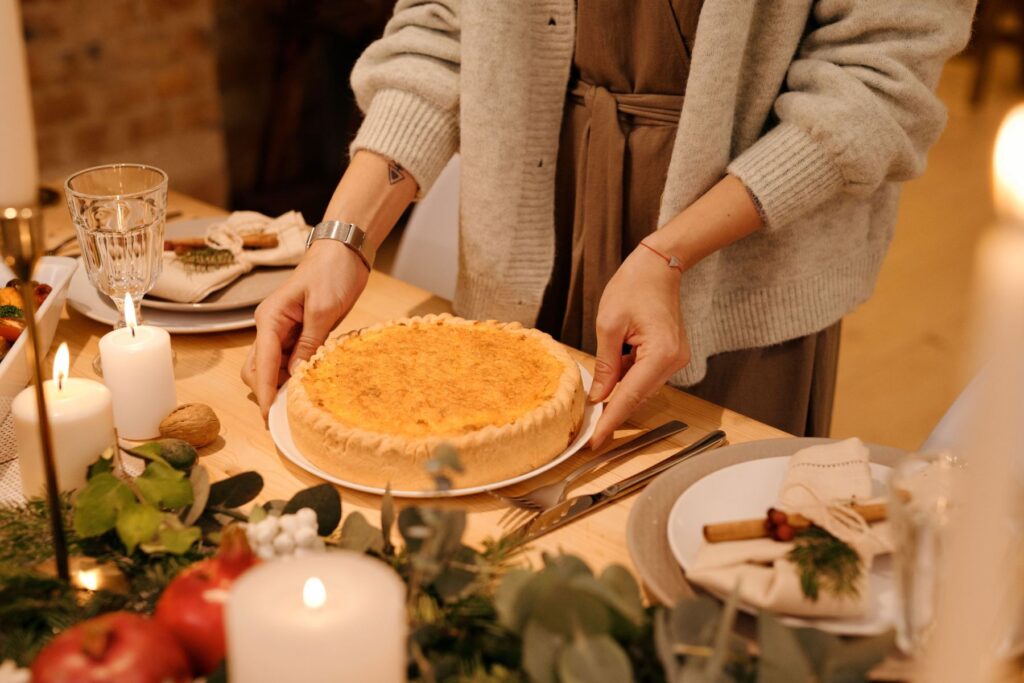
A Friendsgiving potluck is the easiest way to put on a Thanksgiving-sized meal without cooking all of it: one person supplies the table and the main dish, and every guest carries in a piece of the menu.
Whether it works comes down to planning rather than cooking. Without a sign-up organized by category, a group can turn up with a stack of pies and no vegetables, and a host with a single oven can face a line of casseroles that all need reheating at the same moment.
Get the sign-up sheet right and the host cooks just one dish, the main, while the counter fills with food that arrived ready to serve.
What is a Friendsgiving potluck?
Friendsgiving is a Thanksgiving-style meal shared with friends instead of family, held on or close to the holiday. Merriam-Webster traces the word to 2007 and added it to the dictionary in January 2020. It took off in 2011, when a liqueur ad campaign and a reality TV episode both used it, NPR reported.
It is a sizable tradition now. In a 2024 Statista Consumer Insights survey of more than 1,000 US adults, 20% said they planned to spend Thanksgiving with friends, second only to family. The potluck version, where the host coordinates and everyone cooks, spreads both the cost and the work across the group.
1. Pick a date and send the invite
There is no fixed day. Most groups choose a weekend near Thanksgiving so nobody has to pick between friends and family, and the weekend straight after the holiday works well for anyone who missed the one before. A late-afternoon start gives cooks time to finish dishes at home and leaves room for dessert without a late night.
For timing, the Emily Post Institute suggests inviting people anywhere from a few days to three weeks ahead for an informal dinner, and two weeks to two months ahead for a holiday dinner. A potluck needs the longer end of that range, since guests have to plan and shop for a dish. Put the sign-up link in the invitation itself so dish choices start straight away.
2. Decide what the host makes
The host usually takes the main course, because it is the hardest dish to transport and the one everything else is planned around. Emily Stephenson, a cookbook author who wrote The Friendsgiving Handbook, told NPR that a savory galette or a lasagna can stand in as the main, and both make easy vegetarian centerpieces. A stuffed squash or a mushroom Wellington does the same job.
If you are cooking that main for a crowd, make two batches rather than doubling one recipe. The University of Minnesota Extension warns that scaling up baked and thickened dishes can throw them off balance, and that large batches take longer to cook through. The host also supplies the basics nobody thinks to sign up for: plates, cutlery, napkins, serving spoons, water and coffee.
3. Run a sign-up by category
An open “bring whatever you like” invitation is how a potluck ends up lopsided. The fix is a shared sheet (a Google Sheet or a sign-up page works) split into categories with a fixed number of slots in each. Alex Alexander (@itsalexalexander), a Seattle-based author and former wedding and event planner, prefills her Friendsgiving sign-up sheet with these slots: the main, potatoes, rolls, vegetable sides, hearty salads, cranberry sauce, appetizers, desserts, and drinks with and without alcohol.
Guests fill in their dish, any allergies or dietary restrictions and whether they need the oven. She also suggests the host spell out serving sizes and any ingredients to avoid, and set a deadline for signing up and confirming. The oven column is the most useful addition for the host, because it shows trouble a week early. Once a category is full, close it, and send a reminder a day or two before the party with the address, the arrival time and the final dish list.
4. Decide how many dishes to ask for
A simple ratio from home cook Babs Costello, who posts as @brunchwithbabs on TikTok, gets most of the way there. As Apartment Therapy reported, she plans one appetizer, one starchy side, one vegetable side and one dessert for every five guests, along with roughly three bottles of wine for every five.
| Guests | Appetizers | Starchy sides | Vegetable sides | Desserts | Wine |
|---|---|---|---|---|---|
| 5 | 1 | 1 | 1 | 1 | 3 bottles |
| 10 | 2 | 2 | 2 | 2 | 6 bottles |
| 20 | 3 | 3 | 3 | 3 | 12 bottles |
Ask every cook to make a dish that serves at least half the group, since people take a little of everything at a potluck. For dessert, plan on six slices from a 9- or 10-inch pie, the figure pastry chef Zac Young of PieCaken Bakeshop gave Tasting Table. He also noted that many guests want a thin slice of several pies, which argues for variety over one giant dessert.
For drinks, the National Institute on Alcohol Abuse and Alcoholism counts a standard glass of wine as 5 fluid ounces, so a 750 ml bottle pours about five glasses. Ice is easy to underestimate: ice maker Reddy Ice suggests 1 to 2 pounds per person, toward the top of that range if the ice is also chilling bottles. Ice is a good job for the guest who doesn’t cook. Please enjoy responsibly.
5. Plan the oven and fridge before the day
A home kitchen has one oven and one fridge, and a potluck tests both. The University of Minnesota Extension’s crowd-cooking guide says limited oven space should rule out oven-heavy dishes, and that fridge room has to be planned ahead for anything served cold. In practice, that means no more than two or three dishes that need the oven when they arrive.
Ask everyone else for dishes that are good at room temperature or arrive ready to serve. A slow cooker can keep a dish warm on the counter, but it will not reheat cold food safely. Texas A&M AgriLife Extension says hot dishes should be reheated to 165°F on arrival, and that slow cookers and warming trays only hold food that is already hot. A cooler packed with ice makes a good overflow fridge for drinks, which frees the real fridge for salads and pies.
6. Label every dish
At a potluck the host can’t vouch for every recipe, so a small card beside each dish does the work. The plant-based newsletter Plant-Powered Physicians asks guests to label dishes with their main ingredients so anyone with an allergy or a dietary rule can choose quickly.
The card should name the dish, the cook and any of the nine major allergens the FDA lists: milk, eggs, fish, crustacean shellfish, tree nuts, peanuts, wheat, soybeans and sesame. On a vegetarian table, also flag hidden animal ingredients such as chicken stock in stuffing or gelatin in a dessert. Give each dish its own serving spoon so nothing crosses over.
7. Set the table and the running order
Clear a long counter or table for the buffet before anyone arrives, with plates at one end and napkin-wrapped cutlery at the other so guests’ hands stay free. Set out extra serving bowls, since many dishes arrive in the pan they were baked in. A rough schedule keeps it calm:
- Two hours before: main dish in the oven, drinks chilling, the buffet laid out with labels and spoons.
- As guests arrive: cold dishes straight into the fridge, hot dishes into a low oven, and a no-cook appetizer and drinks out.
- About an hour in: finish the dishes that need a final step, add garnishes and eat.
- After the main meal: clear the savory food into the fridge, then bring out dessert and coffee.
Hand out small jobs, too. Lizzie Post and Daniel Post Senning, co-presidents of the etiquette-focused Emily Post Institute, suggest asking guests to greet people at the door, set the table or keep glasses filled. A cleanup crew of two, one washing and one packing leftovers, gets the kitchen back in order before dessert.
8. Keep the food safe and send leftovers home
A buffet that sits out all evening is where a potluck can go wrong. The FDA’s buffet guidance says perishable food shouldn’t stay at room temperature for more than two hours, or one hour above 90°F, unless hot food is held at 140°F or warmer and cold food at 40°F or colder. It also recommends setting out smaller platters and swapping in fresh ones rather than topping up a dish that has been sitting out.
Pie needs the same care. Pumpkin, custard and cream pies belong in the fridge after two hours out, while fruit pies without dairy can stay loosely covered on the counter for up to two days, according to Lisa Peterson, a nutrition and wellness educator at University of Illinois Extension.
Leftovers go into small, shallow containers so they cool quickly. FoodSafety.gov says to eat or freeze them within four days and reheat them to 165°F. Leftovers belong to whoever brought the dish, Lizzie Post told NPR, so keep a stack of takeout containers by the door for anyone who forgot one.
What should guests bring to a Friendsgiving potluck?
The ideal guest dish needs nothing from the host’s kitchen, food writer Casey Elsass, author of What Can I Bring?, said on WNYC’s All Of It: no oven, no burner and no fridge space. He suggested bringing the serving bowl and utensils, packing garnishes such as herbs or nuts to add at the party, and, as he asks his own guests to do, bringing a container for leftovers.
For salads, Plant-Powered Physicians suggests packing the greens apart from the rest and tossing them together at the party. For the drive over, Texas A&M AgriLife Extension says to carry cold dishes at 40°F or below in a cooler with ice or gel packs, and hot ones at 140°F or above in an insulated carrier, wrapped in foil just before leaving. Emily Stephenson’s advice to NPR was to skip soup, which leaves the host with extra bowls to wash. And the Emily Post Institute’s newsletter reminds guests to let the host choose their dish, arrive on time because the meal is being timed, and follow up with a thank-you.
For the host, the sign-up sheet does the most work. Set its categories and slot counts from the table above, add an oven column and a deadline, and most of the problems on the day never happen. The host then has one main dish to cook, a fridge with room in it and a counter full of food that arrived ready to eat.