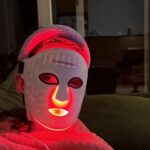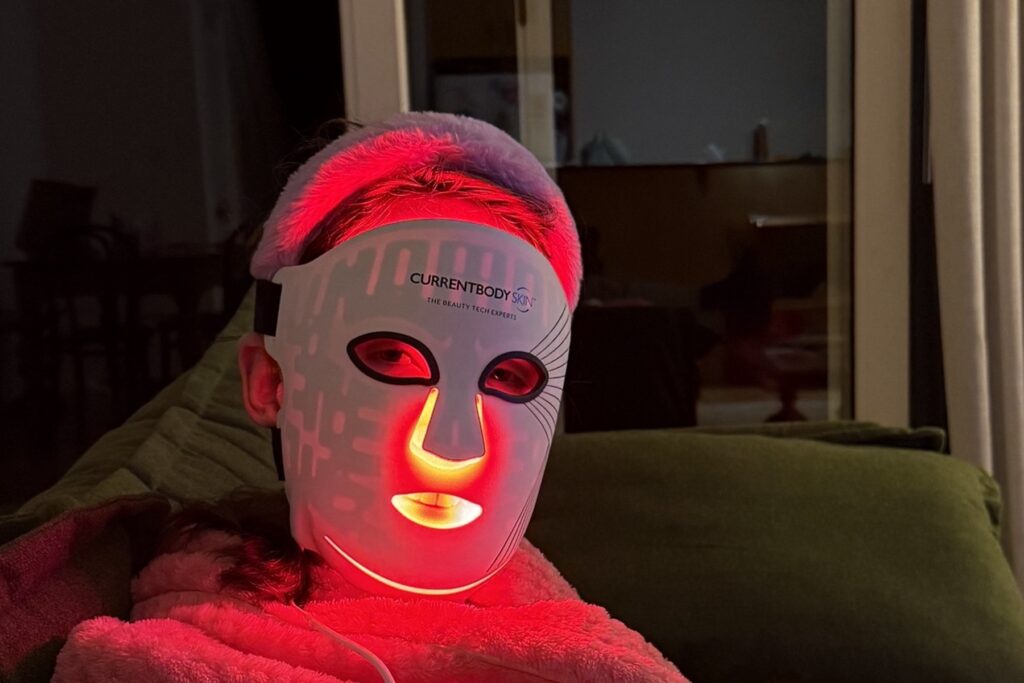
An LED face mask is a wearable mask lined with small light-emitting diodes that shine red, near-infrared or blue light onto the skin while you sit still. The devices started out in dermatology offices and are now widely sold for home use.
Brands market them for fine lines, sagging, redness and breakouts, and home devices often cost from about $100 to more than $1,000, according to the American Academy of Dermatology. Prices vary widely, and so do the specs behind them.
With Black Friday deals coming, the details on a listing matter more than the discount. Many brands do not publish how strong the light is, and “FDA-cleared” means a device is considered low risk, not that it is proven to work.
This article contains affiliate links. If you buy through them, Ritual & Reverie may earn a commission at no cost to you. As an Amazon Associate we earn from qualifying purchases.
What is an LED face mask?
LED stands for light-emitting diode, the same kind of bulb used in phone screens and holiday lights. In a face mask, the diodes give off specific colors of light, measured by wavelength in nanometers (nm, a billionth of a meter). Using red and near-infrared light on the skin is also called photobiomodulation, the American Academy of Dermatology (AAD) explains, and in-office versions are stronger and usually part of a wider plan that can include peels or microneedling.
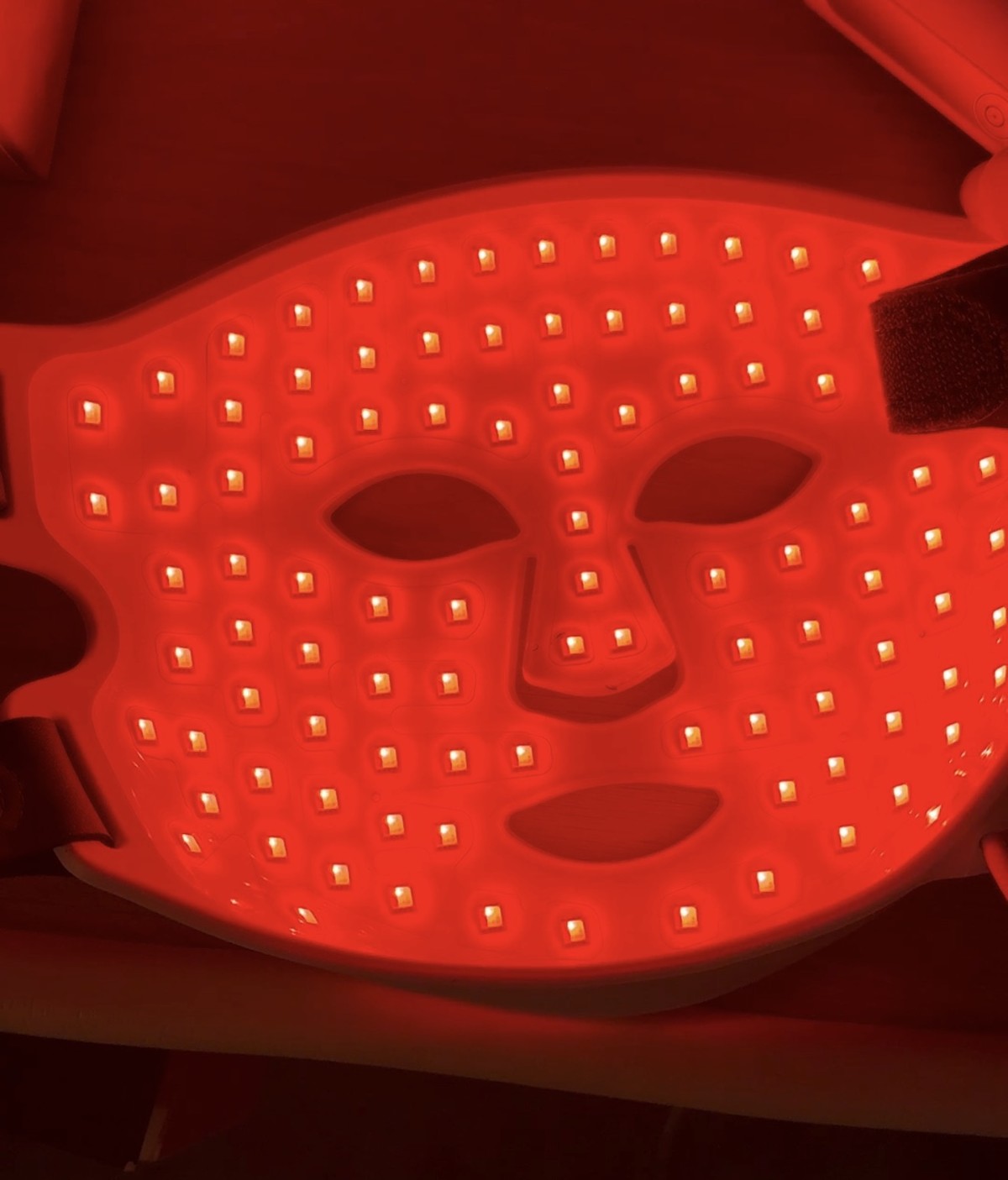
Each color has its own job. New York City dermatologist Jane Yoo, MD, writes on her practice blog that red light, at about 630 to 670 nm, is linked to collagen production; blue light, at about 415 to 430 nm, is used for active breakouts; and near-infrared, which sits just past what the eye can see, is added to some devices to reach deeper.
How the light works is still a theory. Cosmetic chemist Michelle Wong, PhD, creator of the Lab Muffin Beauty Science channel, told NPR’s Short Wave podcast that the leading idea is that red and near-infrared light help the cell’s energy production, but she stressed that the mechanism is not settled.
Do LED face masks work?
The best-known wrinkle study is small but careful. In a 2007 trial published in the Journal of Photochemistry and Photobiology B, 76 people with facial wrinkles had 633 nm red light, 830 nm near-infrared, both, or a sham light twice a week for four weeks. The active groups showed measured wrinkle reduction of up to 36% and more collagen in skin samples. Those are the best results, not the average, the devices were office machines, and follow-up lasted only three months.
A larger 2014 trial in Photomedicine and Laser Surgery followed 136 volunteers through 30 twice-weekly sessions with either red light or a broader red-to-near-infrared light. Blinded raters judged wrinkles improved in 69% of the red-light group and 75% of the broader-light group, against 4% of the comparison group. The paper is open about its weak points: a light-device company paid for it, the comparison group was not randomly chosen and was mostly the sponsor’s employees, and nobody received a fake treatment.
The acne evidence is closer to home use. A 2025 review in JAMA Dermatology pooled six trials of portable or at-home LED devices covering 216 people with mild to moderate acne. Red, blue and combined devices all beat the comparison treatments, with improvement typically showing after 4 to 12 weeks. The total number of people was small and the devices varied widely.
Taken together, the studies point to a modest benefit, and much of the research is company-funded. University of Wisconsin dermatology professor Apple Bodemer, MD, told NBC Select, “There aren’t a lot of high-quality scientific studies available,” though she said there is enough to suggest it may help some people.
How is a home mask different from an in-office treatment?
Power is the main difference. Home masks put out meaningfully less light than office devices, partly for safety, so Dr. Yoo advises expecting gradual, modest change over weeks to months. An office treatment also comes with a professional who controls the dose and can pair the light with other procedures.
Where a home mask wins is cost per use. A $400 mask used four times a week for six months adds up to roughly 100 sessions, or about $4 each, and it keeps working after that. The catch is that the value only appears if the mask comes out of the drawer several times a week.
7 things to check before you buy an LED face mask
1. FDA clearance, worded correctly
Look for “FDA-cleared” or “FDA 510(k) cleared.” A 510(k) is the filing a maker submits to show a new device is substantially equivalent to one already legally sold, according to the US Food and Drug Administration. The AAD notes that clearance signals the device is considered low risk, not that it is proven to work, and that “FDA approved” or “FDA certified” claims mean nothing for these devices. You can look up a brand or device name yourself in the FDA’s 510(k) database. The CurrentBody Skin LED Light Therapy Mask Series 2, for example, is listed under K250966.
2. Wavelengths listed in numbers
A good listing gives exact wavelengths, not just “red light.” The wrinkle trial above used 633 nm red and 830 nm near-infrared, and Dr. Yoo puts acne-fighting blue light at about 415 to 430 nm. For example, Omnilux says its Contour Face mask uses 132 LEDs split evenly between 633 nm red and 830 nm near-infrared. Since blue is used for breakouts and red for collagen, match a mask’s colors to the concern you bought it for.
3. Power output, if the brand shares it
Irradiance, the strength of the light reaching the skin, is usually given in milliwatts per square centimeter (mW/cm²). Many brands do not publish it, and Wong told NPR that the market is poorly standardized and some online listings carry unreliable specs. CurrentBody is one brand that does publish it: its product page lists 30 mW/cm² for the CurrentBody Skin LED Light Therapy Mask: Series 2, alongside red (633 nm), near-infrared (830 nm) and deep near-infrared (1072 nm) light. A brand that shares its irradiance and points to studies on that same device is giving you more to go on than one that does not.
4. Eye protection
Follow each device’s directions on eyewear. If they call for goggles, the AAD says to wear the ones supplied every time, because sunglasses are not a substitute. With a mask that has no eye cutouts, Boston plastic surgeon Jaimie DeRosa, MD, told NBC Select to wear goggles or at least keep your eyes closed. Blue light deserves the most care: a 2020 case report in the journal Medicine described a 37-year-old woman who developed distorted vision, diagnosed as light-induced retinal damage, after using a blue LED mask. It was a single case, so how common this is remains unknown.
5. A full-face fit
A full-face mask or large panel gives more even coverage than a small handheld wand, and the light should sit on or very close to the skin, TIME reported. Wands cost less but have to be moved spot by spot. Beyond that, think about comfort: flexible silicone masks bend to the face, rigid shells are heavier, and a cordless mask is easier to wear while you do something else for 10 minutes.
6. A price that matches what you get
At the time of writing, the Omnilux Contour Face recommended by Dr. Bodemer was listed at $395, and the MZ Skin Lightmax Supercharged LED Mask 2.0 recommended by Dr. DeRosa was $950, per NBC Select. Seattle dermatologist Heather Rogers, MD, told TIME her favorite brands are Celluma and Omnilux. In a sale, compare the price with what the same mask cost a month ago, and remember a discount only matters on a mask that ticks the boxes above.
7. A real return window
Wong told NPR to buy from a company with a good return policy. That matters more than usual at Black Friday, when some deals are marked final sale. Buying from the brand or an authorized retailer also makes a warranty claim easier.
How to use an LED face mask
Start with clean, dry skin and never go past the recommended session time, Scottsdale dermatologist Jennifer Sawaya, MD, told TIME. Most brands suggest about 10 minutes a session.
Frequency matters as much as length. Most devices are designed for three to five sessions a week, which is not the same as daily. “I think a lot of people do think more is better,” Wong said on NPR, adding that people who used devices too bright or for too long have reported broken blood vessels and dark spots getting darker.
Afterward, carry on with your usual routine. The dermatologists interviewed by TIME suggest following a session with moisturizer and continuing to wear sunscreen. Dr. Yoo is clear that a mask does not replace sunscreen, a basic skincare routine or medical treatment for a significant skin problem. Clean the mask the way the maker’s instructions say, especially if more than one person in the house uses it.
How long until you see results?
Results take months, not weeks. Rachel Reynolds, MD, interim chair of dermatology at Beth Israel Deaconess Medical Center in Boston, told Harvard Health Publishing that results take regular sessions several times a week, kept up for four to six months.
Results also are not permanent. The AAD says ongoing treatment is needed because skin keeps aging, and that the long-term effects of red light on the skin are not yet known.
Is an LED face mask safe, and who should skip it?
In the short term, red light therapy appears safe and has not been linked to skin cancer the way ultraviolet light has, according to the AAD. Side effects are usually mild and temporary, such as slight irritation.
Some people should talk to a dermatologist first. Cleveland Clinic dermatologist Jennifer Lucas, MD, told the Cleveland Clinic newsroom not to use red light therapy if you have a photosensitive disorder, such as burning or blistering easily in the sun, or take medication that makes you sun-sensitive, including certain antibiotics and some blood pressure medications.
Melasma, a condition that causes patches of brown pigment on the face, is another reason to pause, since Dr. Rogers told TIME that light therapy can make it worse. People with darker skin have a higher risk of lasting redness or discoloration, so Margaretta Masse, MD, medical director of dermatology for the Manhattan division of Northwell Health, suggests starting with lower, shorter sessions and building up, she told the American Medical Association. If you are pregnant, Dr. Yoo suggests checking with your OB as a general precaution.
This article is for general information and is not medical advice.
LED face mask FAQ
Is FDA-cleared the same as FDA-approved?
No. Clearance means the FDA judged the device comparable to one already on the market, while approval belongs to a separate pathway, according to the FDA. For LED masks, “FDA-cleared” is the claim to look for.
Can you use an LED face mask every day?
Only if that device’s directions say so. Most are designed for three to five sessions a week, and using a mask more often or for longer than directed has been linked by users to broken blood vessels and darker spots.
Is red or blue light better for acne?
Both can help. The JAMA Dermatology review found red, blue and combined devices all improved mild to moderate acne. A 2024 review in the Journal of Drugs in Dermatology described a split-face trial of 33 people in which adding red light to blue cleared more spots than blue alone.
Do LED masks really help with wrinkles?
They can, modestly. Dr. Masse told the AMA that collagen and wrinkle depth can be measured with ultrasound and other tools. “There is a difference on a microscopic level, but not everybody will feel that there’s a clinical difference,” she said.
The verdict
An LED face mask is worth buying for someone who will use it three to five times a week for at least a few months and wants a gentle add-on, not a dramatic fix. Before checkout, check four things: the words “FDA-cleared,” wavelengths listed in nanometers, clear eyewear directions and a return window long enough to give it a fair trial. If you have melasma or take a light-sensitizing medication, book a dermatologist visit before you add one to your cart.